The Integrated Circuit
Before 1958, building a computer meant hand-soldering a city. Each transistor was a separate house. Each resistor and capacitor was its own house too. A worker stood at a bench and connected those houses with copper wire, one joint at a time. Add a thousand parts and you needed a thousand joints, and the machine fell over the day one of them cracked. The whole industry hit a wall called the tyranny of numbers — the engineers could draw a circuit with a million parts on paper, but no human hand could wire it.
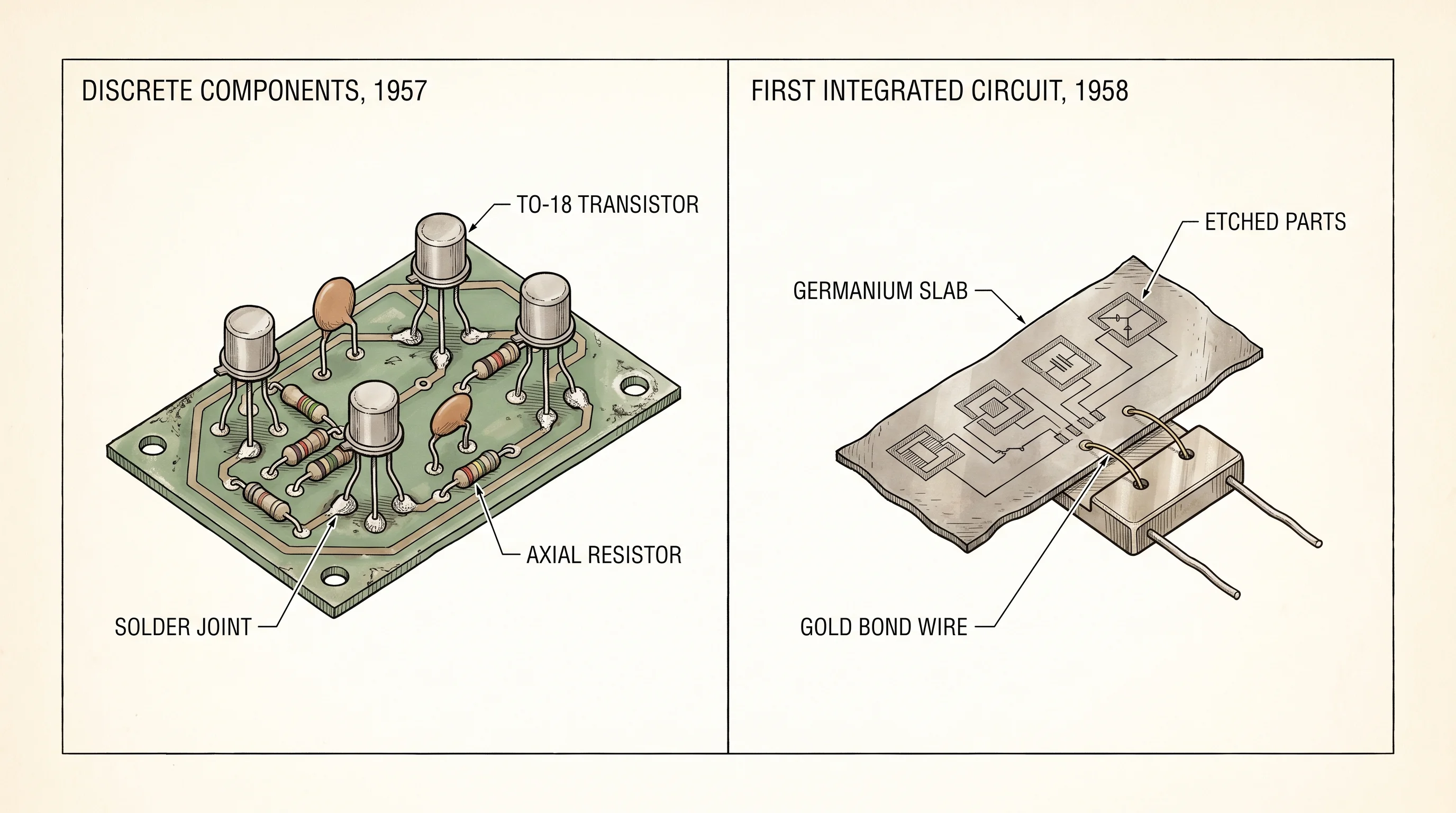
Jack Kilby walked into Texas Instruments in May 1958 as a brand-new hire with no vacation days. While everyone else was on summer break he sat alone in an empty lab and asked a question nobody had bothered to ask. If silicon can be made into a transistor, why not make the resistor and the capacitor out of silicon too — and carve all of them out of the same single slab. On September 12 of that year he flipped a switch on his prototype and a green wave drew itself on the oscilloscope. The whole circuit, five parts, lived on one chip of germanium the size of a paper clip.
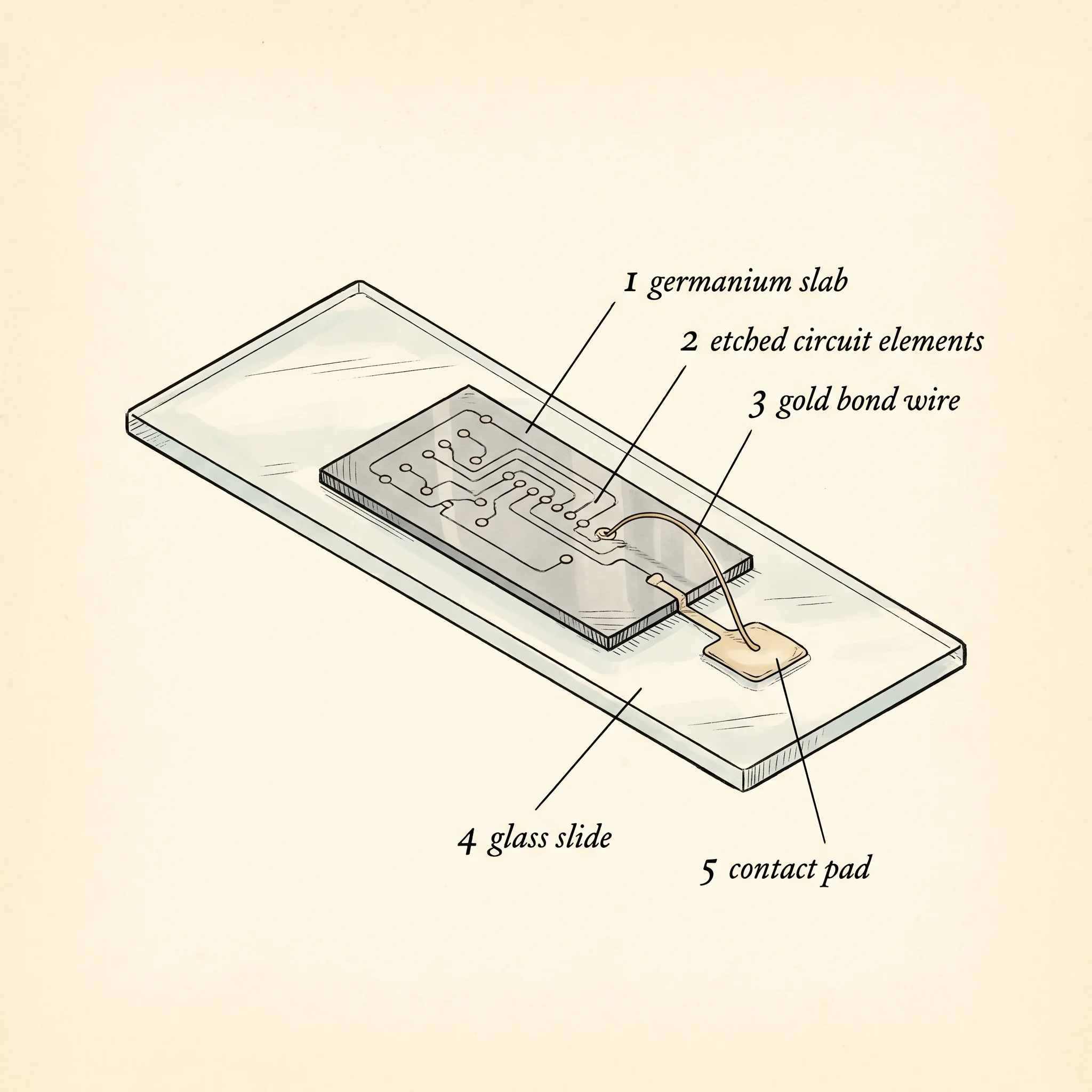
Six months later, three hundred miles up the coast, Robert Noyce at Fairchild solved the part Kilby had not. Kilby's slab still needed tiny gold wires to connect the parts together — the houses were on one block, but the streets were still hand-laid. Noyce realized you could print the wires onto the same slab as a thin layer of aluminum, using the same photographic process you already used to draw the transistors. That gave you the houses and the streets in one shot, every chip the same as the last. The two men filed competing patents, fought in court for ten years, and in 1969 settled by sharing the credit. Kilby got the Nobel Prize in 2000. Noyce had died in 1990 and the prize is not given to the dead.
The reason this mattered is not romance. It is the slope of a chart. Once a circuit was something a camera printed instead of something a human soldered, the number of parts you could fit on one slab stopped being limited by hands and started being limited by the lens. Each new generation of lens drew finer lines. Each finer line meant smaller parts. Each smaller part meant more parts on the same square of silicon. Look at the count.
fn main() {
    let chips = [
        ("1958  Kilby phase-shift oscillator", 5),
        ("1961  Fairchild Micrologic flip-flop", 4),
        ("1965  Moore's prediction begins", 64),
        ("1971  Intel 4004 microprocessor", 2_300),
        ("1989  Intel 80486", 1_180_235),
        ("2024  Apple M4 (CPU + GPU + NPU)", 28_000_000_000_u64),
    ];

    println!("year  chip                                  parts on one slab");
    println!("---------------------------------------------------------------");
    for (label, parts) in chips {
        println!("{:<38}  {:>18}", label, parts);
    }
}
Compile and run it the same way you ran the program in the first lesson. You should see this.
year  chip                                  parts on one slab
---------------------------------------------------------------
1958  Kilby phase-shift oscillator                       5
1961  Fairchild Micrologic flip-flop                     4
1965  Moore's prediction begins                         64
1971  Intel 4004 microprocessor                       2300
1989  Intel 80486                                  1180235
2024  Apple M4 (CPU + GPU + NPU)               28000000000
Read the right column from top to bottom. Kilby's first chip held 5 parts. Thirteen years later the Intel 4004 held 2,300 — a whole CPU on one slab, which is the next lesson. Today an Apple M4 holds twenty-eight billion. The doubling did not happen because anyone got smarter. It happened because Kilby and Noyce changed the unit of work from one transistor to one chip, and from that day forward every improvement in the camera multiplied the part count for free.
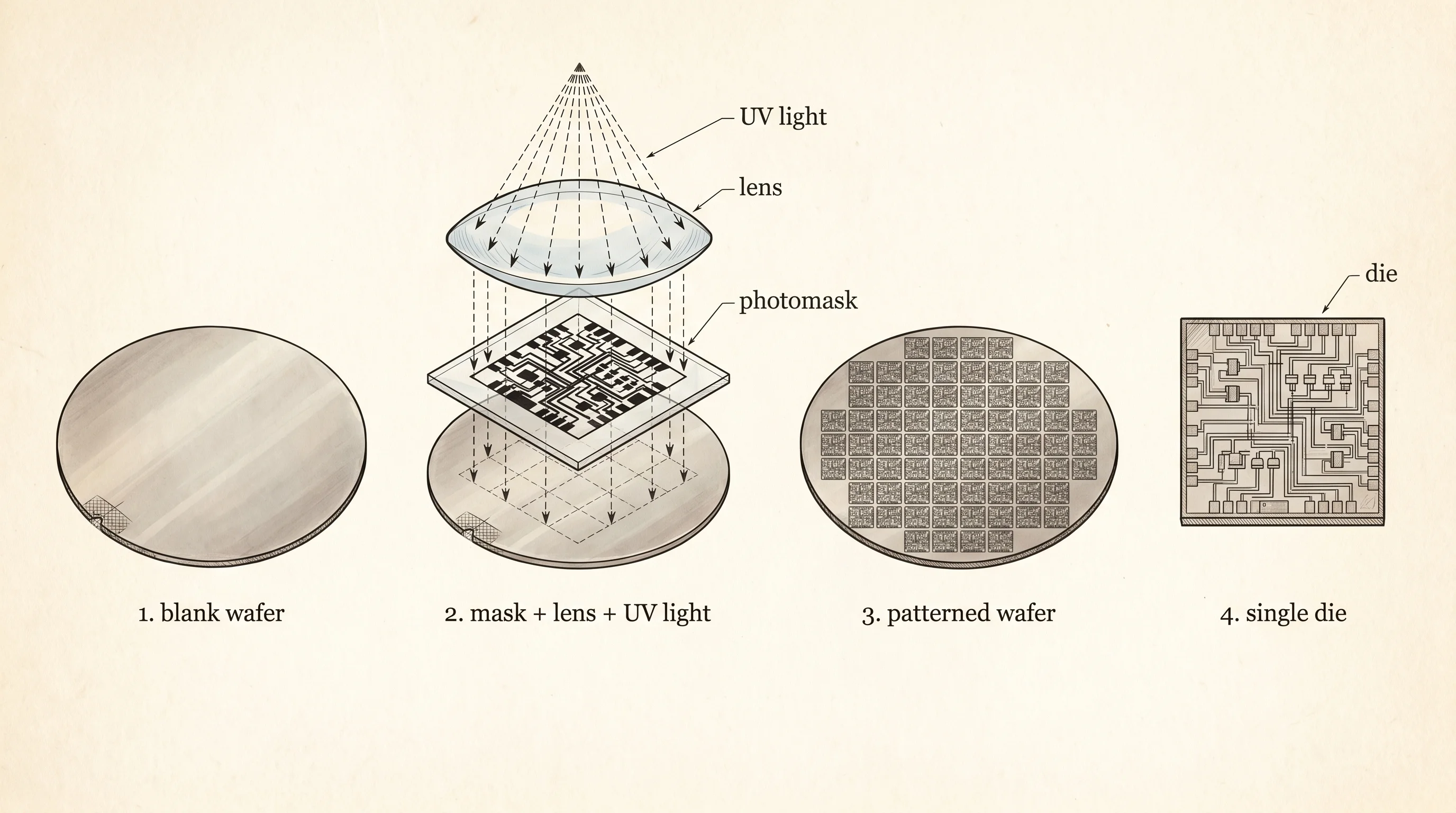
The first integrated circuit was the moment computing stopped being a craft and started being a printing press. Every chip you have ever owned is a descendant of Kilby's paper-clip-sized slab. Your phone, your laptop, the GPU training language models in a data center — same trick, finer lens.
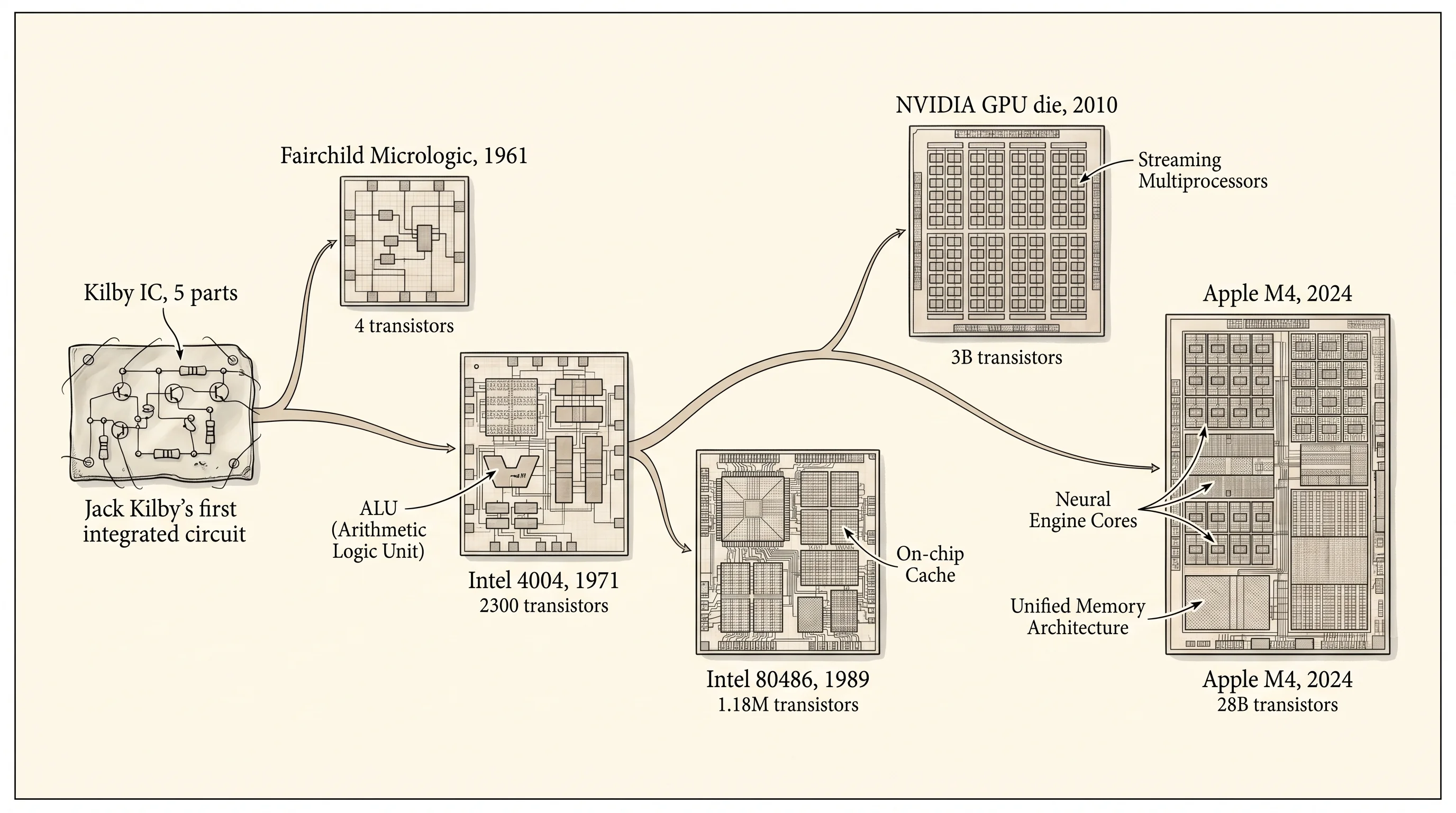
A slab full of parts is not yet a computer — that wait took another thirteen years and is the next lesson.